Burst Pipe? What to Do Right Now (A Plumber's 6-Step Guide)
Burst pipe? What to do first: turn the water off at the stopcock, then make the electrics safe. Do those two things in the first minute and you've stopped most of the damage. Then work down the list below and ring a WaterSafe approved plumber, like our 24/7 emergency call-out team.
Burst pipe: what to do right now
- Turn off the stopcock. Nine times out of ten it's under the kitchen sink, behind the bleach. Turn it clockwise until it stops.
- Make the electrics safe. If water is anywhere near sockets, light fittings or the fuse board, switch off at the consumer unit. Dry hands only.
- Switch off the boiler, central heating and immersion heater.
- Open the taps to drain the pipes. Cold first, then hot, and flush the toilets.
- Catch what you can. Bowls under the drip, towels down, valuables out of the way. Wrap the split tightly with a cloth or tape for now.
- Call a plumber, then photograph the damage for your insurer.
Need someone now? Call 07939 923815. We answer the phone 24 hours a day, 7 days a week, across Surrey and Berkshire. We're WaterSafe approved and Gas Safe registered (930171).
If you smell gas at any point, get out and call the National Gas Emergency number on 0800 111 999.
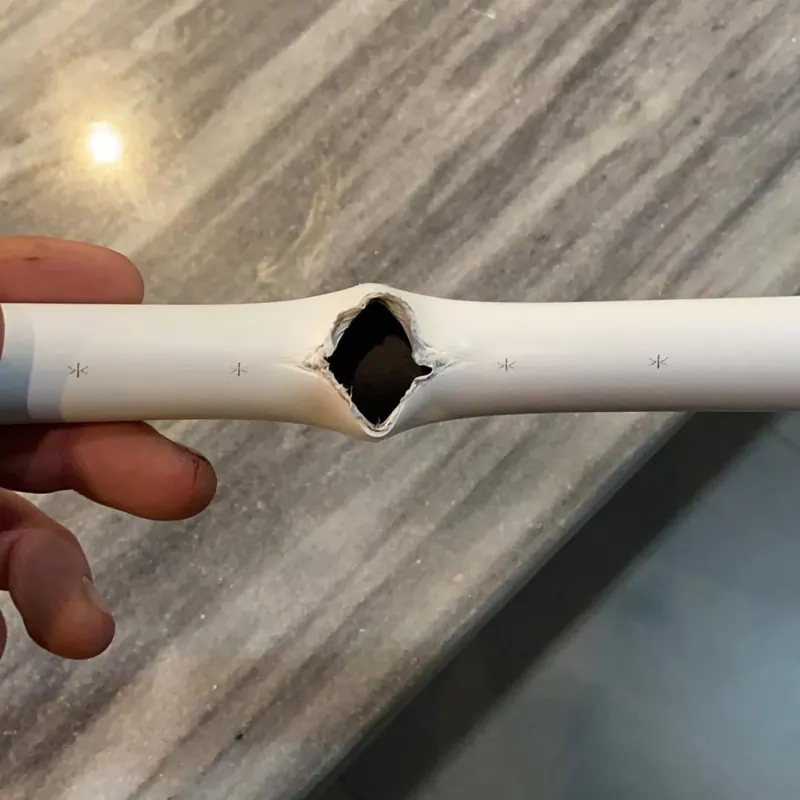
This is what a burst usually looks like once you find it. The pipe swells first, then tears open along the weak spot.
Water still running after you've turned off the stopcock?
Then a tank in the loft is almost certainly feeding it. The stopcock only stops the mains. Whatever is sitting in that tank will keep draining down, and in older houses with a gravity (vented) system it feeds the hot water cylinder and often the bathroom cold taps too.
To stop it:
- Follow the pipe out of the bottom of the tank and look for a gate valve, usually with a round wheel handle, often red. Turn it clockwise.
- No valve, or it won't budge? Open the hot taps and the bathroom cold taps so the tank empties faster.
- Make sure the immersion heater is off before you do, so it can't run dry.
Take a torch up there. Loft hatches always seem to be over the one bit of floor that isn't boarded.
Stopcock won't turn, or can't find it?
Don't force it. We've seen people snap the spindle on a stiff old stopcock, and then you've got two leaks instead of one. Give it one firm, steady turn with a cloth for grip. If it still won't go, head outside.
Most homes have an outside stop tap too, under a small cover in the pavement or at the edge of the front garden. You'll usually need a long stop tap key from a builders' merchant to reach it, and it shuts off the whole house. Worth buying one before you need it.
Can't find the stopcock at all? WaterSafe has a guide to the usual places to look.
Some Victorian terraces share a supply, so the stopcock for yours may actually be next door.
Is it the water company's pipe or yours?
Inside your home or on your land, it's usually yours, so call a plumber. Water coming up through the road or pavement is one for the water company.
Roughly, the water company looks after the pipes in the street up to your boundary, often up to the outside stop tap. The supply pipe from there into the house, and everything inside, is usually down to the homeowner (Thames Water explains more). Surrey and Berkshire are split between Thames Water, SES Water, South East Water and Affinity Water, so check your bill to see which one you're with.
Not every leak is plumbing, either. One customer's review mentions a same-day visit where the fault turned out to be the drains, so we brought in a drains specialist rather than pretend otherwise.
Frozen pipe, not burst yet: how to thaw it safely
No water from a tap, or just a trickle, on a freezing morning usually means a frozen pipe. Find it before it splits. Water expands by nearly 10% when it freezes, according to SES Water, and that's what splits pipes and pushes joints apart. The frozen bit is usually somewhere cold and exposed: the loft, a garage wall, the pipe to an outside tap. You can sometimes spot frost on it, or feel that one section is far colder than the rest.
To thaw it:
- Turn off the stopcock first, in case it's already split.
- Open the tap the pipe feeds, so melting water has somewhere to go.
- Start at the tap end and work back towards the frozen section.
- Use gentle heat: a hot water bottle, warm towels, or a hairdryer on low, kept moving and away from water.
- Never use a blowtorch, heat gun or naked flame. It can melt plastic pipe, crack soldered joints and set fire to the loft.
Skip the kettle as well. Boiling water on a frozen joint can crack it. The Met Office has more on frozen or burst pipes.
Combi boiler stopped in a cold snap? Check the condensate pipe
If your combi shows a fault and gurgles on a frosty morning, the condensate pipe outside has probably frozen. It's the thin plastic pipe, usually white or grey, running from the boiler out to a drain. This is one of the most common winter call-outs there is.
Pour warm (not boiling) water along the outside section, then reset the boiler as the manual says. Won't restart? Our Gas Safe engineers handle boiler repairs.
How to find a hidden burst
Pipes under floors and in ceilings can leak for days before anyone notices. Look out for a damp patch that keeps growing, water through a ceiling, the sound of running water when nothing is on, a sudden drop in pressure, or a boiler that keeps losing pressure.
The meter test: turn off every tap and appliance that uses water, read the meter, and leave it an hour. If the numbers have moved, water is going somewhere. Many meters also have a small spinning dial or star that turns even when the flow is tiny.
Turning the water back on after a burst
Once the pipe is fixed, bring the water back slowly:
- Close all the taps you opened to drain down.
- Open the stopcock slowly, a quarter turn at a time.
- Check the repair and any joints nearby for drips.
- Open each tap in turn to let the air out, starting with the kitchen cold. Expect a bit of spitting and banging for a minute.
- Check the boiler pressure. If the heating lost water it will need topping up.
If water got into the boiler or its controls, don't switch it on until a Gas Safe engineer has looked at it. Same with the consumer unit: if it got wet, have an electrician check it before you put the power back on.
Burst pipes and your insurance
Most home insurance policies cover sudden "escape of water", but check your own policy and ring your insurer early. The ABI says insurers settled about 12,000 weather-related burst pipe claims in 2023 (Insurance Times).
Before you clean up, photograph the leak and anything damaged, and keep the cut-out bit of pipe if you can. Get the emergency repair done to stop the water, but check with your insurer before booking anything bigger. Ask your plumber for a short written note of what caused the burst and what they did. Insurers nearly always ask for one.
Where pipes burst in Surrey and Berkshire homes
- Victorian terraces: old lead or iron supply pipes, stopcocks nobody has turned in years, shared supplies, and pipes in cold outside walls or under suspended timber floors.
- Period cottages: loft tanks, unheated lofts and outbuildings, outside toilets and outside taps.
- New-build estates: plastic push-fit pipework, which still freezes and can pop at the joints, stopcocks hidden behind kitchen kickboards or in the garage, and exposed combi condensate pipes.
Hard water makes all of this worse. Most of Surrey and east Berkshire is hard water, and limescale builds up inside stopcocks and valves until they seize, usually on the one night you need them. It does the same inside boilers (hard water in Surrey and your boiler). Our advice: turn your stopcock off and on again every six months so it stays free.
We cover the whole of Surrey and Berkshire from our base in Lightwater, including Camberley, Woking, Guildford, Cobham, Virginia Water, Englefield Green, Ascot and Sunningdale.

How to stop it happening again
- Find your stopcock now, check it turns, and label it.
- Lag pipes in the loft, garage, under floors and on outside walls. Lag the loft tank too, but not underneath it, so warmth from the house can still reach it.
- Cover outside taps and turn off their isolating valve for winter.
- Leave the heating on low if you're away in a cold spell.
- Fix dripping taps and overflows. A slow drip freezes faster than you'd think.
- Get small leaks looked at early. Our general plumbing service sorts stiff stopcocks, isolating valves, lagging and weeping joints.
A radiator that's stopped working leaves that room cold, and the pipes in it exposed, so get it sorted before the frost. You can see some of our heating work in the gallery.
Why call CJS for a burst pipe
We've been in the trade 15 years, we're 5.0 on Google from 18 reviews, and customers mention same-day visits:
"We had a leaking boiler that needed urgent attention. Called CJS and [he] came out the same day." (Joe G.)
"[He] fixed our leaking shower" and "he was quick, really knew his stuff and his price was fair. No drama." (Sian M.)
More on our reviews page.
Water coming through now? Turn off the stopcock, then call 07939 923815, day or night. Our 24/7 emergency plumbers will talk you through what to do next and get someone out. For anything that can wait, use our contact form.
About the author
The CJS team, CJS Heating & Plumbing, Lightwater, Surrey. 15 years in the trade. Gas Safe registered (930171), WaterSafe approved and APHC licensed. Emergency plumbing, boilers and heating across Surrey and Berkshire, with the phone answered 24/7 on 07939 923815.