Combi vs System Boiler: Which Suits Your Surrey Home?
In the combi vs system boiler choice, a combi suits most homes with one bathroom: it heats water on demand, needs no cylinder and no loft tank. A system boiler with an unvented cylinder suits homes where two or more showers run at once. If your mains flow is weak, neither may be right, and keeping a regular boiler can be the better call.
We're a Gas Safe registered team (no. 930171) with 15 years in the trade, and we fit all three types across Surrey and Berkshire. What follows is what we'd tell you standing in your kitchen on a survey.
Last updated: November 2026
Key facts
- Combi: hot water straight from the mains, on demand. Best for 1 bathroom and smaller homes.
- System boiler plus unvented cylinder: stored hot water at mains pressure. Best when 2 or more showers run at the same time.
- Regular (heat only) boiler: keeps the loft tanks and a vented cylinder. Often right for older homes with weak mains flow.
- The deciding number is mains flow, not boiler size. You can measure it yourself in 60 seconds (see below).
- Surrey water is hard. Scale protection matters most on a combi.
Combi vs system vs regular boiler: side by side
| Combi | System boiler + unvented cylinder | Regular boiler + tanks | |
|---|---|---|---|
| How hot water is made | Heated on demand as it flows from the mains | Heated and stored in a cylinder | Heated and stored in a vented cylinder fed from a loft tank |
| Best for | Flats and homes with 1 bathroom | Homes with 2 or more bathrooms used together | Older homes with weak mains or old pipework |
| Showers at once | 1 comfortably | 2 or more, if the mains can keep up | Depends on the tank, cylinder and any pump |
| Space needed | Boiler only | Boiler plus a cylinder cupboard | Boiler, cylinder cupboard and loft tanks |
| Mains flow needed | Good flow essential | Good flow essential | Not reliant on mains flow |
| Loft tanks | None | None | Cold water tank and a small feed tank |
| Heat pump ready | No, a heat pump needs a cylinder | Yes, the cylinder space is already there | Cylinder space is there, may need upgrading |
| Hard water impact | Scale builds in the plate heat exchanger and shows quickly | Scale builds on the cylinder coil more slowly | Scale builds on the cylinder coil more slowly |
| Hot water if the boiler fails | None | Many cylinders have an electric immersion backup | Many cylinders have an electric immersion backup |
When we price a new boiler installation, we start from this table and your house, not from a brand. We fit Vaillant, Worcester Bosch, Glow-worm and Potterton, and we'll recommend whichever one suits the job.
Combi vs system boiler: how each one works
Combi boiler
A combi does two jobs in one box. Most of the time it's running your radiators. Open a hot tap and a diverter valve inside flips it over to hot water, heating the mains supply as it passes through a plate heat exchanger. Nothing is stored. No cylinder, nothing in the loft.
That's also why you wait a few seconds for hot water at the far end of the house. The boiler has to fire up and push the cold water out of the pipe first.
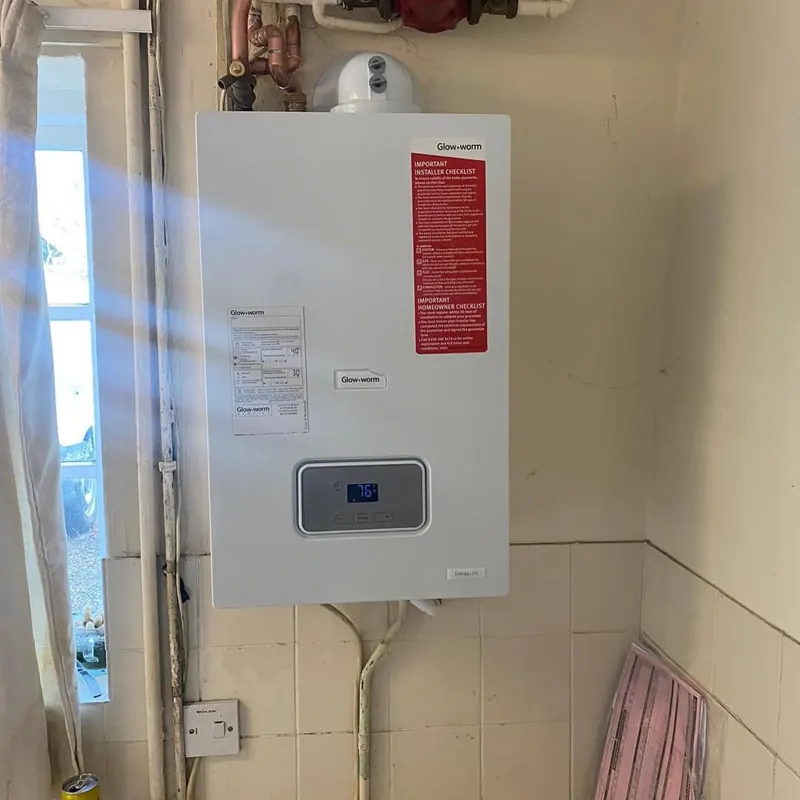
The photo above is one of ours: a Glow-worm combi on a kitchen wall, display showing the flow temperature.
System boiler with an unvented cylinder
A system boiler only heats. It pumps hot water through a coil inside the cylinder, so you've always got a tank of hot water ready. The cylinder is unvented, meaning it's fed straight off the mains, so every tap and shower gets mains pressure and several can run together.
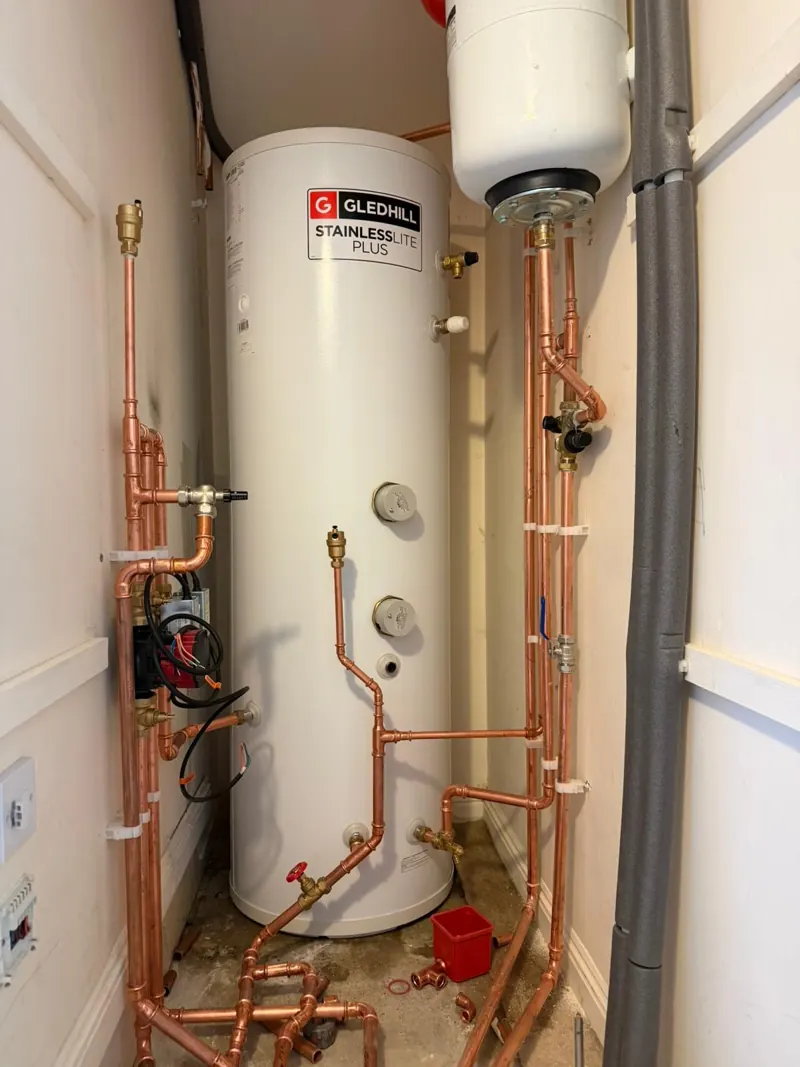
This is an unvented cylinder we installed: a Gledhill StainlessLite Plus, expansion vessel above it, new copper run in.
Regular boiler (heat only)
Also heats a cylinder, but this one is vented. A cold water tank in the loft feeds it, and a small feed and expansion tank looks after the heating. The pressure at your taps comes from gravity alone, which is why so many older houses have a pump bolted in next to the cylinder.
The real question: how many hot taps at once?
One bathroom: a combi. One shower at a time is exactly what a combi is built for, and you get a cupboard back.
Two bathrooms: it depends on overlap. If two of you are regularly in the shower at the same time on a weekday morning, a standard combi splits its flow between them and both go weak. If the en suite hardly ever runs alongside the main bathroom, a combi can still be fine. There are two in between options:
- High output combi. More hot water per minute, but only if your mains can actually feed it.
- Storage combi. A combi with a small hot water store built in. It covers short overlaps without giving up a whole cupboard.
Three or more bathrooms: a system boiler with an unvented cylinder. Worcester Bosch tells installers the same thing, recommending system or regular boilers for homes with more than two bathrooms.
Don't forget baths. A combi can only heat so many litres a minute, so filling a big bath takes noticeably longer than off a cylinder. If you're a bath every night household, factor that in.
Check your mains flow (60 second bucket test)
A combi and an unvented cylinder both live or die on the mains. If it can't deliver, a bigger boiler won't fix it. And a pressure reading on its own can fool you; it's flow that fills a shower. Here's how to check it yourself:
- Find a bucket and mark the 10 litre line (measure it in with a jug if there is no scale).
- Use the cold tap nearest to where the water comes in, usually the kitchen tap. Make sure nothing else is running in the house.
- Open the tap fully and time how many seconds it takes to fill to 10 litres.
- Divide 600 by the number of seconds. That is your flow in litres per minute. For example, 10 litres in 40 seconds is 15 litres per minute.
- Repeat it at a busy time of day, such as a weekday morning, as flow often drops then.
Now look at the hot water flow rate on the combi's spec sheet, in litres per minute. If your mains can't match it, the combi will never hit that number. Bear in mind those figures are quoted for a set temperature rise, and the water coming in is colder in January, so expect a bit less in winter.
Unvented cylinders have a minimum too. Heatrae Sadia, for example, asks for at least 1.5 bar of pressure and 20 litres per minute for its Megaflo Eco cylinder, and warns that even at that level flow may be poor when several outlets run at once. Other makers ask for similar or slightly more, so check the manual for whichever model you're quoted.
Do the test before anyone quotes you. It saves a lot of guesswork.
Which suits your home? Surrey and Berkshire house types
We work on everything from Victorian terraces to new build estates, and the choice usually falls like this.
| House type | What we usually find | What usually suits it |
|---|---|---|
| 1 or 2 bed flat or new estate starter home | One bathroom, little cupboard space | A combi |
| Victorian terrace or period cottage | Often loft tanks, old pipework, sometimes a long or lead supply pipe | Test the flow first. A combi if flow and pipework allow, otherwise keep a regular boiler |
| 3 or 4 bed family home with an en suite | Two bathrooms that may be used together | High output combi, storage combi, or system boiler with an unvented cylinder, depending on overlap and flow |
| Large detached home with 3 or more bathrooms | Several showers and baths at busy times | A system boiler with an unvented cylinder |
Older homes are where we slow down. Going from an open vented system with loft tanks to a sealed combi or system boiler puts the heating pipework under more pressure than it's used to. Old radiator valves and joints that were dry for decades on a vented system can start to weep. We'd rather find that before the switch than after. If you've already gone sealed and the pressure keeps dropping, see why a boiler keeps losing pressure.
Unvented cylinder vs combi: unvented cylinders explained
An unvented cylinder holds hot water under mains pressure. That's what gives you two strong showers at once, and it's also why the rules around them are strict.
- Part G of the Building Regulations covers it. Section G3 of Approved Document G sets the safety requirements for hot water storage, including unvented systems.
- It must be fitted by a qualified installer. The work has to be signed off, either through building control or by an installer registered with a competent person scheme.
- It has several safety devices. A temperature and pressure relief valve, an expansion vessel (the white tank in our photo) and a discharge pipe through a tundish to a safe outlet.
- It needs an annual check. The safety valves and expansion vessel charge should be checked every year, and this can be done alongside a boiler service.
One thing worth knowing: if you ever see water dripping through the tundish (the little open funnel on the pipework by the cylinder), call someone. It usually means the expansion vessel has lost its charge or a valve is letting by.
Our view? Only ever one shower running, go combi and take the cupboard back. Two or more regularly, with decent mains flow, and the cylinder wins every time.
Hard water and combis in Surrey
Most of Surrey and east Berkshire is hard water, and it hits a combi harder than a cylinder.
The plate heat exchanger in a combi has narrow channels. Scale builds there quickly and you feel it in the shower: water that goes hot, cold, hot again, or never quite gets there. A cylinder coil scales up too, just more slowly, and you rarely notice it day to day.
On new installs we fit a scale reducer where it's needed, which is what building regulations guidance expects on combis in hard water areas. The yearly service keeps an eye on it from there. More on the signs and fixes in hard water in Surrey and your boiler.
Thinking about a heat pump later?
A heat pump works with a hot water cylinder. It can't run like a combi. So if there's any chance you'll switch in the next ten years, think about it now.
Got a cylinder cupboard already? We'd think twice before ripping it out for a combi. Finding that space again later, and running new pipework to it, is a bigger job than keeping it. Going the other way, if you've got a combi and room to spare, a system boiler and cylinder is a step towards a heat pump.
Regular boilers: when to keep the tanks
Plenty of people assume a regular boiler is old hat. It isn't. We often recommend keeping one when:
- Mains flow is weak. A combi or unvented cylinder would give you poor showers. A gravity system with a pump doesn't care what the mains is doing.
- The pipework is old. Staying open vented means older radiators and joints never see sealed system pressure.
- There's a good loft tank set up already. Like for like is often simpler and less disruptive.
What changes the cost
We don't publish prices, because every house is different. These are the things that move the number:
- Like for like or a change of type. Combi out, combi in is the simplest job we do. Changing type means more pipework.
- Whether a cylinder is needed. Adding, replacing or removing one changes the parts and the time on site.
- Removing loft tanks. Taking them out and capping off the old pipework adds work.
- Moving the boiler. A new spot means new gas, water and condensate runs and a new flue.
- Pipework and radiator upgrades. Older systems sometimes need work before they can go sealed.
- Scale protection and system cleaning. A scale reducer, and sometimes a power flush to clear out sludge so it doesn't end up in the new boiler.
You get a fixed quote, agreed before we start. Finance is available, and we register the manufacturer guarantee for you.
How we help you choose
We come out, look at your bathrooms, pipework and water supply, and talk you through the options in plain English. Our rule is simple: "If something is not worth fixing, we tell you, even if it means a smaller job for us." Same with boilers. If a combi is wrong for your house, we'll say so.
One customer put it like this: "I contacted multiple plumbers and was quoted an arm and a leg … explained the problem gave me a few options, we then decided to do a boiler installation and it was a great success." (Terry M.)
Another, after a new boiler and radiator: "The boiler was installed neatly, and the radiator looks great and works perfectly. Everything was left clean and tidy." (Calum M.) And from a family who had just moved in: "fitted us a new boiler system and sorted our gas certificate … make the process go very smoothly." (Rebecca A.)
We're rated 5.0 on Google from 18 reviews. Read them on our reviews page, or see more installs in our gallery. Not sure your boiler actually needs replacing yet? Start with the signs you need a new boiler.
Get the right boiler for your house
We cover all of Surrey and Berkshire from our base in Lightwater. Call 07939 923815, answered 24 hours a day, 7 days a week, or send us your details for a free quote. Tell us how your house uses hot water and we'll tell you honestly which boiler fits.