Signs You Need a New Boiler: 8 Warnings and When a Repair Will Do
The clearest signs you need a new boiler are age (over 10 to 15 years), breakdowns that keep coming back, parts that are no longer made, and leaks or corrosion inside the case. Noise, slow radiators and rising bills can point the same way, but on their own they are often a repair, not a replacement.
We're a Gas Safe registered heating company based in Lightwater, 15 years in the trade, fitting and fixing boilers across Surrey and Berkshire. If yours ticks several of the boxes below, have a look at our boiler installation service. If it ticks one, a boiler repair visit is usually the place to start.
The eight signs, in short:
- It is more than 10 to 15 years old.
- It breaks down more than once a year.
- Parts for it are hard to get or discontinued.
- It leaks, or there is rust and corrosion inside the case.
- It bangs, gurgles or "kettles".
- Radiators heat slowly or the hot water is weak.
- Your gas bills climb while your use stays the same.
- You see a yellow or orange flame, soot marks or smell fumes.
How long do boilers last?
Most gas boilers last 10 to 15 years. A decent boiler that gets serviced every year can go well past that. One that's never been looked at, sitting on hard water with no scale protection, often won't make ten.
Age on its own is not a reason to rip a boiler out. We see plenty of 15 year old boilers that still run fine because someone has had them serviced every year. That yearly boiler service is also when we spot the worn part that would otherwise go in January.
8 signs you need a new boiler
1. It is over 10 to 15 years old
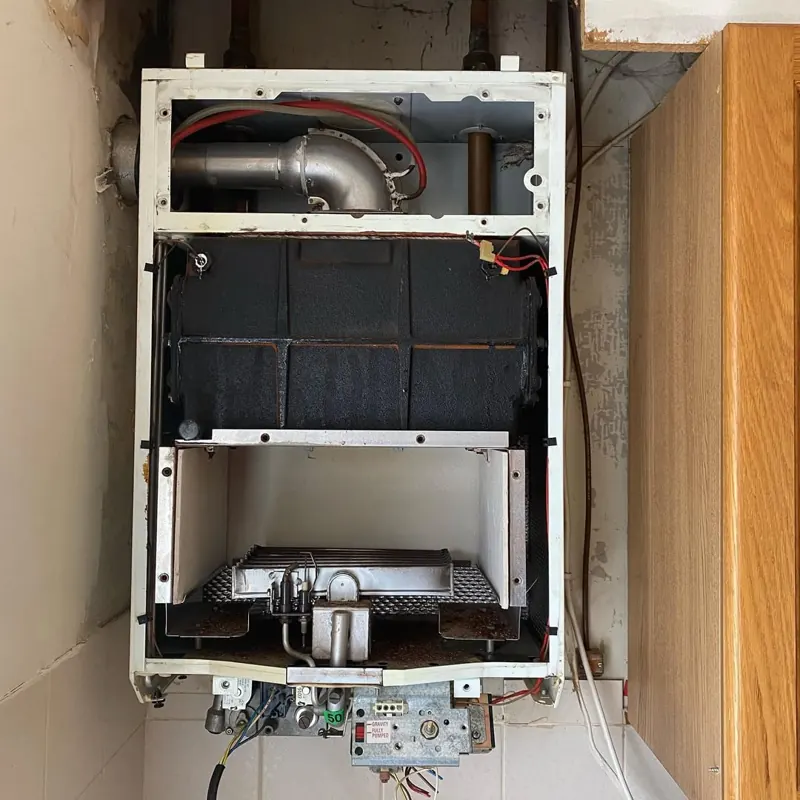
By this point the main parts tend to wear out together: fan, pump, gas valve, circuit board. If yours still has a pilot light you can see through a little window, or a "gravity / pumped" switch on the front, it is most likely 20 years old or more.
Still reliable? Then keep servicing it and keep an eye on it. We'd never tell you to replace an old boiler that doesn't let you down just because of its age.
2. It breaks down more than once a year
Any boiler can have one fault in a year. Two or three in one winter usually means parts are failing one after another, and each fix just buys time until the next.
The first callout is almost always worth a repair. Once you're ringing an engineer every few months, honestly, that money is better going towards a new boiler.
3. Parts are hard to get or no longer made
Manufacturers stop making parts for older models. If the circuit board, gas valve or heat exchanger has been discontinued, one breakdown can leave you without heating for days while someone hunts down a reconditioned part.
Sometimes it's still fixable. We'll check whether the part can actually be had before you decide anything.
4. Leaks, drips or corrosion
Look underneath the boiler and along the pipes. Water in the cupboard, a damp patch on the ceiling below, or green or white crust on the fittings all need looking at. Outside, a copper pipe dripping from the wall near the boiler is often the pressure relief valve letting water go.
Most leaks are a valve or a seal, which is a standard fix. As Joe G. put it: "We had a leaking boiler that needed urgent attention. Called CJS and [he] came out the same day. … he explained the problem and the fix in a way that actually made sense." The one that changes things is a corroded heat exchanger inside the case on an older boiler. That is usually the end of it. If your boiler keeps losing pressure, read why a boiler keeps losing pressure first, because that's usually fixable.
5. Banging, gurgling or kettling
Kettling sounds just like it says: a rumble like a kettle coming to the boil. In Surrey, nine times out of ten it's limescale on the heat exchanger making the water overheat and boil in spots. Gurgling is usually air in the system. Banging can be a pump on its way out, or sludge.
Caught early, most of this is a repair. If scale or corrosion has eaten into an older boiler, replacing it starts to make more sense.
6. Slow radiators or poor hot water
Cold at the top of a radiator? It needs bleeding. Cold at the bottom, or the whole house taking an age to warm up, usually means sludge in the pipes. When you bleed a radiator and the water comes out black, that's the sludge. On a combi, hot water that runs hot then cold is often scale or a worn diverter valve.
A lot of the time this is nothing to do with the boiler itself. A power flush clears the sludge out of the radiators and pipework, and the boiler stays where it is.
7. Rising bills and low efficiency
Old non-condensing boilers rated G on the old SEDBUK scale run at under 70% efficiency. Every new gas boiler fitted in England has to reach at least 92%. If your bills keep going up and your use hasn't, an old, inefficient boiler is a likely culprit.
This one isn't really a repair. A service keeps an old boiler running as well as it can, but it won't turn it into a condensing boiler.
8. Yellow flame, soot or a smell of fumes
A gas flame should burn blue. A lazy yellow or orange flame, black soot marks on or around the case, or a pilot light that keeps going out can all mean the gas isn't burning properly. That can produce carbon monoxide.
It might be fixable, but treat it as a safety problem first and get it checked straight away.
Safety first: carbon monoxide
Carbon monoxide has no smell or colour. The NHS lists the symptoms as headaches, dizziness, feeling or being sick, tiredness and confusion, stomach pain and shortness of breath. They often ease when you leave the house.
If you smell gas or think there is a carbon monoxide leak: turn the boiler off if it is safe to do so, open doors and windows, get everyone outside and call the National Gas Emergency number on 0800 111 999. Get medical advice if anyone feels unwell. Do not take the boiler case off or try to fix it yourself. Only a Gas Safe registered engineer should work on it.
Repair or replace? Our honest rule of thumb
Repair it if it's reliable and parts are available. Keep an eye on it if it's getting on but behaving. Replace it when faults keep coming back, parts are gone or it's unsafe. And as we always say: "If something is not worth fixing, we tell you, even if it means a smaller job for us."
| Repair | Keep an eye on it | Replace | |
|---|---|---|---|
| Age | Under 10 years | 10 to 15 years and still reliable | Over 15 years with other signs on this list |
| Fault history | First fault in years | One fault a year | Several breakdowns in a year |
| Parts | Readily available | Getting harder to find | Discontinued or only reconditioned |
| Safety | Fixed and passed on test | Checked at every service | Heat exchanger or flue unsafe and not worth fixing |
| Efficiency | Condensing boiler running well | Bills creeping up | Old non-condensing, G-rated boiler |
Not sure which column you're in? Book a boiler repair visit. We'll find the fault, talk you through the options and agree the price before we touch anything.
Hard water: why Surrey boilers wear out faster
Most of Surrey and east Berkshire has hard water. You'll know it from the white crust on your kettle and taps. Heat that water and the minerals drop out as scale, which builds up in the boiler's heat exchanger, so it has to work harder to heat the same water.
That's where the kettling comes from, along with hot water that goes hot then cold and higher gas use. Leave it long enough and the heat exchanger or diverter valve fails. Combis get the worst of it because they heat fresh mains water every time you turn a tap on.
What slows it down:
- A scale reducer on the incoming mains. We fit one on new installations where it's needed and can add one to an existing boiler.
- A yearly service, so we spot the scale before it causes a breakdown.
- A clean system. Sludge and scale together will finish a boiler early.
There's more in our guide to hard water in Surrey and your boiler.
What the rules say about new boilers
Since April 2018, every gas boiler fitted in England must be at least 92% efficient (ErP) and come with time and temperature controls. A combi install also needs one extra energy saving measure, such as weather compensation or smart controls. The details are in the government's Boiler Plus factsheet.
Landlords: the 2022 alarm regulations require a carbon monoxide alarm in any room with a fixed combustion appliance, such as a gas boiler (gas cookers are excluded). The government's explanatory booklet for landlords sets out who has to do what, and our landlord gas safety service covers the yearly check.
Thinking of coming off gas altogether? We also do heat pump installation.
What happens when we replace your boiler
We come and look first, explain your options and agree a price before any work starts. Then we fit it, register the manufacturer guarantee for you and hand over the paperwork.
- Survey and advice. We look at the boiler, flue, gas supply and radiators, and tell you whether a combi, system or regular boiler suits your home. Our guide to combi vs system boilers explains the difference.
- Brand and model. We fit Vaillant, Worcester Bosch, Glow-worm and Potterton, and we'll recommend the one we think suits your house.
- Price agreed first. No surprises once we've started. Finance is available.
- Fitting. We cover your floors, clean and treat the system so the new boiler starts on clean water, fit the controls and tidy up after ourselves. As a guide, Viessmann puts a straight like-for-like swap at around a day, and moving the boiler or changing type (say, a regular system to a combi) at about two, because new pipework is usually needed.
- Paperwork. We register the manufacturer guarantee in your name and notify the job through Gas Safe, so you get the Building Regulations compliance certificate.
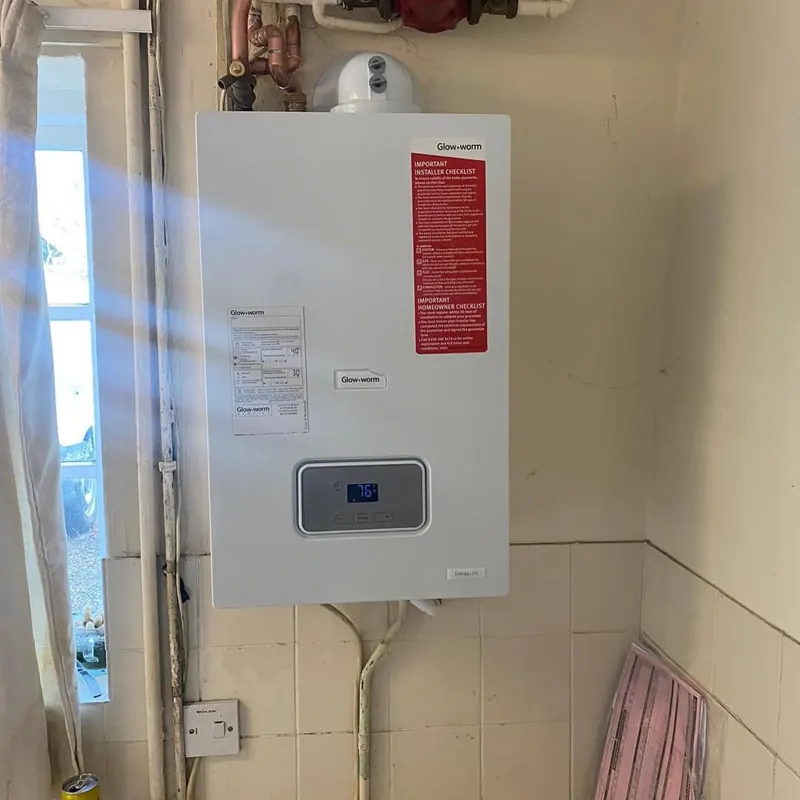
That Glow-worm is one of ours, photographed at handover with the manufacturer's installer checklist still on the front. There's more of our work in the gallery.
What customers say after a boiler replacement:
"I contacted multiple plumbers and was quoted an arm and a leg … explained the problem gave me a few options, we then decided to do a boiler installation and it was a great success." (Terry M.)
"The boiler was installed neatly, and the radiator looks great and works perfectly. Everything was left clean and tidy." (Calum M.)
"fitted us a new boiler system and sorted our gas certificate … make the process go very smoothly." (Rebecca A.)
We're rated 5.0 on Google from 18 reviews. The rest are on our reviews page.
Not sure if your boiler needs replacing?
We answer the phone 24/7 and cover all of Surrey and Berkshire, from our base in Lightwater to Camberley, Woking, Guildford and Ascot. Call 07939 923815 or contact us to book a visit. We'll look at your boiler and tell you straight whether it needs a repair or a replacement. If it's the second, we'll take you through our new boiler installations.